Sights in Tenerife: what’s worth it and what costs a whole day
Updated September 9, 2026 · 8 min read

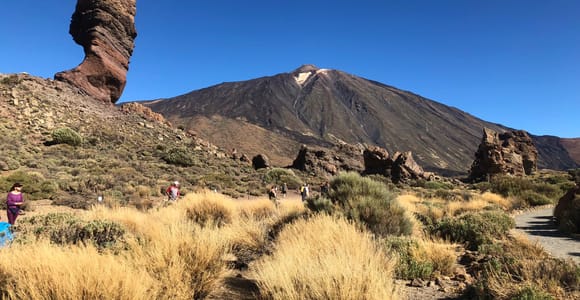
Tenerife can be explained with a single number: 3,715 metres. That is how high Mount Teide rises above an island that measures less than fifty kilometres at its widest point. A mountain this size on so little land turns one island into two – the north-east trade wind hits the northern slopes, leaves its moisture there, and arrives in the south dry.
From this single fact follows almost everything travellers here have to figure out: why the north is green and the south isn’t, why the boats leave from the south-west, why Costa Adeje gets rain on around 36 days a year, and why you can drive in one morning from palm trees into a landscape that freezes at night.
The listings this page compares run to 307 deals from €6, with a median price of €66. 62 of them mention Teide in the title alone. That’s the island’s pecking order, in one line.
Mount Teide: the reason most people come
The national park has been a UNESCO World Heritage Site since June 2007 and, with around 5.1 million visitors in 2025, is Spain’s most visited national park. On August days, more than 15,000 people are there at once. Anyone after solitude comes early or in the evening.
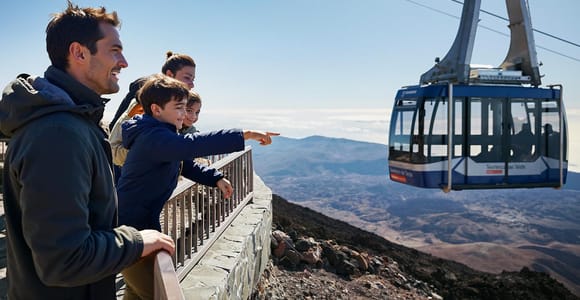
The cable car takes you from 2,356 to 3,555 metres in eight minutes without a single step. At the top it’s around fifteen degrees colder than at sea level, and in too much wind the cable car stops running – that happens more often than the brochures let on. The final 160 metres of ascent to the crater are trail 10, Telesforo Bravo: 0.69 kilometres with gradients of up to 60%, and it requires a reservation through the Tenerife ON platform, bookable up to 56 days in advance.
Since 19 January 2026, this trail has also come with a fee. Non-residents pay €15 and residents of the other Canary Islands €6; for Tenerife residents and children under 14 it stays free. The money goes towards maintaining the park. For families, that means the summit is a regulated high-alpine destination, not something you fit in between breakfast and the beach – the Mount Teide tours with cable car ticket and transfer, 74 deals from €20, take you to the upper cable car station, not the crater.
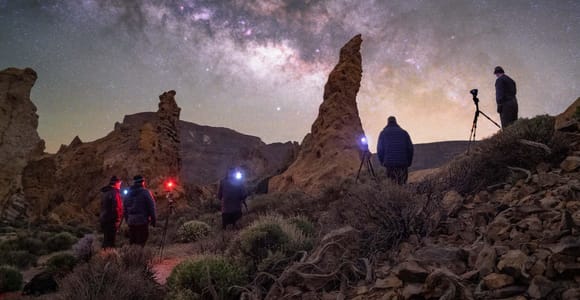
The mountain’s other half is the night. Because the summit sits above the cloud layer, the sky here is among the clearest in Europe; 15 of the listings are star-gazing or sunset trips. It’s cold up there, and you won’t be back until well after midnight. Anyone planning this with children can find the age question under Tenerife with kids.
The west: sheer cliffs and a gorge that needs booking
At Los Gigantes, the cliffs drop 500–800 m straight into the Atlantic. The wall is best seen from the water, which is exactly what the 13 Los Gigantes boat trips from €25 are for. From land you see the edge, not the height.
Behind it, the Barranco de Masca opens out. Since its reopening, the gorge has been strictly regulated: around five kilometres one way, about four hours downhill, minimum age eight, a helmet is provided and must be worn, and without closed hiking boots with a proper tread, nobody gets past the entrance – trainers and sandals are turned away at the visitor centre. Access costs from €40.66 per person and must be booked in advance; the return leg is usually by boat to Los Gigantes. Fourteen of the listings mention Masca in the title, most of them as a boat trip without the hike.
Right at the north-western tip lies Punta de Teno, a lighthouse on black rock overlooking the cliffs. The access road, the TF-445, is closed to private vehicles, pedestrians and bicycles alike. To get there you take the Titsa bus on line 369 from Buenavista del Norte, about twenty minutes for €1 per ride: daily between 10am and 7pm from October to June, and between 8am and 8pm in high summer. Taxis and vehicles with a disabled badge are exempt. Roadworks can suspend access entirely for a while – worth checking before you set off.
The north: the older half
Puerto de la Cruz was a seaside resort before the hotel blocks went up in the south, and it has stayed one – 14 of the listings start or end here. Loro Parque sits on the edge of town, the black-sand Playa Jardín in front of it, and the seawater pools of Lago Martiánez are the north’s answer to an Atlantic that rarely invites you in for a swim here.
La Orotava above it has the manor houses and wooden balconies Tenerife was known for before mass tourism. Icod de los Vinos has the Drago Milenario, a dragon tree whose age is put at somewhere between eight hundred and a thousand years, depending on the source – nobody knows exactly, because these trees don’t form annual rings. Below the town lies Cueva del Viento, at around 18 kilometres the longest lava tube in Europe. Visits are guided only, a maximum of fifteen people at a time, for about €25, and by advance booking only.
Garachico is the place where you can see history: in 1706, a lava flow ran through what was then the island’s most important harbour and filled it in. What remained are the natural pools of El Caletón – solidified lava that the sea now sits in.
And La Laguna, the old capital, has been a UNESCO World Heritage Site since 1999. The reason is its layout: an unfortified town planned on the drawing board, whose grid plan was later copied again and again across Latin America.
Anaga and the eastern tip
The Anaga mountains are the oldest part of the island and a biosphere reserve since 2015. Laurel forest grows in the ravines, a type of vegetation that has barely survived anywhere else in Europe: cloud forest that combs its water out of the cloud instead of the rain. Below lie Taganana and the black beaches of Benijo, above them a network of trails you don’t take on as an afterthought. Ten listings go there.
Santa Cruz is the administrative capital and port, with Calatrava’s Auditorio as its landmark and Playa de las Teresitas in front of it – pale sand shipped in from the Western Sahara in the sixties, because the island itself has none. Eleven listings name the city in the title. Anyone coming in February should know the carnival here is one of the biggest in the world, and the city becomes a different place.
The water: the part you only get here
Off the south-west coast lies the Teno-Rasca marine protected area, designated Europe’s first Whale Heritage Site in early 2021. Short-finned pilot whales and bottlenose dolphins live there year-round, about twenty minutes off the coast by boat. That’s the real difference from almost every other whale-watching destination: there’s no season to wait for. 38 listings sit under Whale and dolphin watching, from €26.40, and the island’s most-booked trip is one of them.
What doesn’t happen is worth knowing beforehand: the boats keep their distance, stay with a group for a limited time, and touching or swimming with the animals is forbidden. Underwater, it continues under Snorkelling and diving, 50 listings from €22.95 – and on land, for everything that’s neither boat nor mountain, under Buggy and quad tours from €56.95.
What you can really do in a week
The honest answer is: not everything. From Costa Adeje to Puerto de la Cruz is a good hour, to the Anaga mountains more like two. Anyone staying in the south who wants to see Teide, the north-west, and Anaga should set aside three days for it – and shouldn’t schedule them back to back.
Two mistakes cost most travellers their best day. The first: Teide and the north coast on the same day. That’s nine hours, five of them spent in the car. The second: judging the north by the weather in the south. When the sun is shining at Costa Adeje, there can be an unbroken layer of cloud over La Orotava – and on some winter days, it’s the other way round, with the north having the clearer sky.
The south itself is a chapter of its own: 67 of the 307 listings name a place there in the title, against 38 for the whole of the north. Which coastal town suits whom, and where which boat departs from, is covered in The south of Tenerife.
Anyone travelling with young children can find choices sorted by age under Tenerife with a toddler and Tenerife with a baby; what to settle before booking any boat trip is covered under Boat trip with kids – minimum age.