Dolphin show or wild watching in Tenerife: choosing with children
Updated September 12, 2026 · 5 min read

A dolphin presentation and a wild whale-watching trip answer different wishes. One offers an organised programme in a park; the other asks children to look for animals whose movements are not arranged for visitors. Neither becomes the right family purchase just because its booking page says “educational”. The practical question is what your child enjoys doing between the exciting moments.
On Tenerife, this decision also changes the geography of your day. Loro Parque is in Puerto de la Cruz, while the short sea trips considered here use the southern and western departure harbours. Before comparing animals, compare where you are staying and how much of your child’s patience the journey will already use.
What the child is actually watching
Loro Parque describes its dolphin presentation as a programme showing the animals’ abilities and communicating conservation information. It currently lists a duration of twenty minutes. Check the day’s programme for the sessions; there is no reason to build a whole transfer plan around a timetable copied into a travel article.
The presentation has an arranged focus. Parents can explain what is happening and the child knows where to look. What it does not show is an unplanned encounter with an animal choosing its own route through the ocean. That difference is worth naming plainly, without asking a young child to settle the entire debate about keeping cetaceans in captivity.
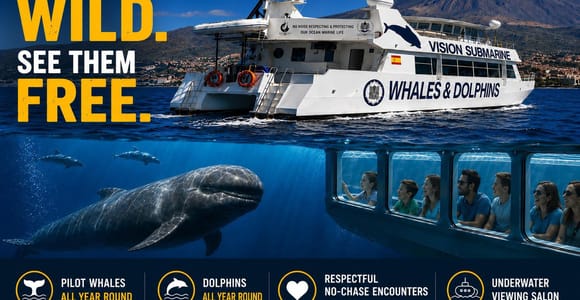
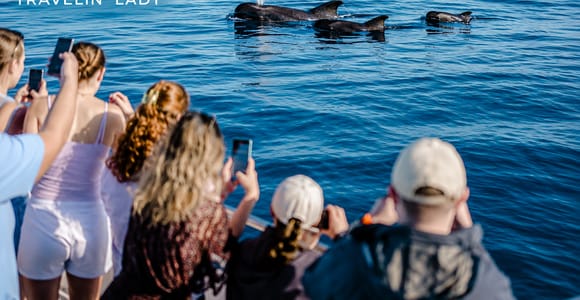
On a wild trip, much of the activity is looking across the water and listening to the crew. Animals may surface briefly, disappear, or be easier for an adult to spot than a small child. The photograph on the ticket page is a possible moment, not the view from every seat throughout the departure.
The cost comparison needs the whole outing
The listings dated 12 September 2026 show Loro Parque admission, offer 407432, from €44, with 14,513 reviews. The ticket with hotel transfers from southern Tenerife, offer 57756, starts at €65 for an eight-hour excursion. These are different products; the transfer package adds €21 at the stored starting prices.
The No-Chase encounter, offer 406165, starts at €28 for an hour and a half, with 15,139 reviews. The Los Gigantes trip with a swim stop, offer 603483, starts at €28 for two hours. A park admission buys a wider park visit, while the boat ticket buys a defined departure. Comparing €44 and €28 does not compare equal amounts of entertainment.
Do not multiply either starting price by four and call it a family quote. Children’s prices, participation rules and availability need the ages and the date in the booking calendar. Our Loro Parque ticket guide separates the admission and transfer decisions in more detail.
Breaks are the most useful difference
In a park, you can decide to stop walking and move on from one part of your programme. A booked transfer still fixes the wider day, so an eight-hour excursion is a poor choice if you need to return whenever your child has had enough. Travelling independently gives a different kind of flexibility, with its own transport cost.
On a boat, you stay aboard until the departure returns. An hour and a half may sound brief to adults, but it is still a commitment for a child who dislikes the movement or loses interest after the first sighting. Extending to two hours adds a different programme, including a possible swim stop, rather than a guarantee of more dolphins.
Ask about shade, a usable toilet and life jackets in your child’s size on the actual vessel. Also clarify whether a child can remain aboard during a swim stop and who supervises them. Photos cannot establish these arrangements. For seasickness or sun-protection questions, consult a pharmacist or paediatrician.
What they learn depends partly on you
I would prepare a simple observation task for a wild trip: look for an animal returning to the surface, notice whether others are nearby, and ask the crew what they can identify. It gives the waiting a purpose without turning the outing into a test. Avoid promising a jump or a close approach.
After a presentation, you can ask what was part of the organised programme and what the animals might do differently in the sea. This is a suggestion for a conversation, not a claim that one visit produces a measurable educational result. An enthusiastic child may remember the boat ride or the park playground more than the conservation explanation.
Captivity and wild watching both deserve questions
If you do not want to fund cetacean captivity, choose another outing rather than treating the dolphin presentation as unavoidable. Loro Parque’s wider admission does not remove that personal decision. Our ticket guide covers the park’s position and the criticism; this family comparison does not resolve the welfare debate through customer ratings.
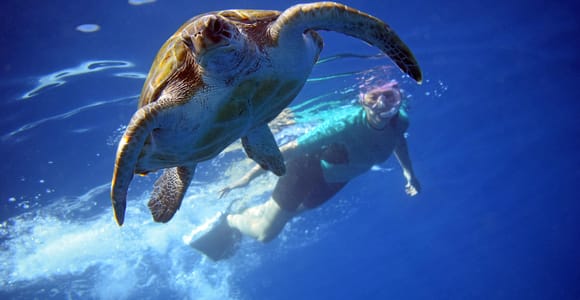
Wild watching also needs scrutiny. The official Tenerife whale-watching guidance rules out swimming with cetaceans. A swim stop is a separate activity, not permission to enter the water beside them.
Operators set different age limits; check the individual booking page. If your child only wants a guaranteed performance, explain the uncertainty before choosing whale and dolphin watching. If the main concern is how long they can stay aboard, use our family guide to boat-trip duration before selecting a departure.